Monday, July 4, 2011

Grey turns to gold on a Blue Monday


It happened again this afternoon. When I looked out the window I saw a grey afternoon, clouds sweeping over the mountain and a wind that shook the pine tree next door. Not exactly inviting weather for an amble on the mountain.
Homoglossum priori - fancy name for a six-pointed star that shines on the mountain in winter.
But wait. Jan arrived home early on this, a miserable Blue Monday. He dragged me out the house by the scruff of my waterproof jacket and announced that we were walking up to the Saddle. If you look up at Devils Peak, you’ll see the saddle at its bottom right, before it slopes upwards to the top of Table Mountain.
And then the grey afternoon was transformed by alchemy as the late sun broke through underneath the clouds and washed the mountain with pure gold. It’s one of those wonderful mysteries of Table Mountain. Don’t believe it when it looks miserable from your window. Just be brave enough to tie up your boots and get outside and let that clear light touch you and breathe the fresh cold air that carries a hint of buchu on its breath.
Below Devils Peak the slopes were star studded with six-pointed red flowers. Homoglossum priori swayed in the chilly southeaster, catching the sun in their petals, turning this flower from the Iridaceae family into a red-gold creation. Popularly named Rooi Afrikaner they flowered next to the path, in the cracks of rocks and next to the stream up on the Saddle.
Which brings me to one of my favourite spots in the whole world: a patch of soft grass sheltered by a huge rock in the middle of the Saddle. Here you can lie back on the softest grass bed (check for ticks afterwards), listen to the stream tinkle and catch an orange-breasted sunbird hopping onto a bush in front of you. We ate a sweet orange and rinsed our hands in the icy stream. No Blue Monday stands a chance against this. It’s called Heaven.
The Saddle is a world in itself. A freezing wind galloped ahead of a bank of clouds that poured down the mountain, lost us in mist and five minutes later cleared to let the sunlight back, dancing over the disco-green leaves of watsonias, pelargoniums and leucadendrons. As a last special bonus, the sky lit up around Lion’s Head in a candy-pink sunset that faded into thick creamy clouds that soon became grey again. Which just goes to show: don’t let the grey clouds bully you.

Friday, June 17, 2011

Home sweet home


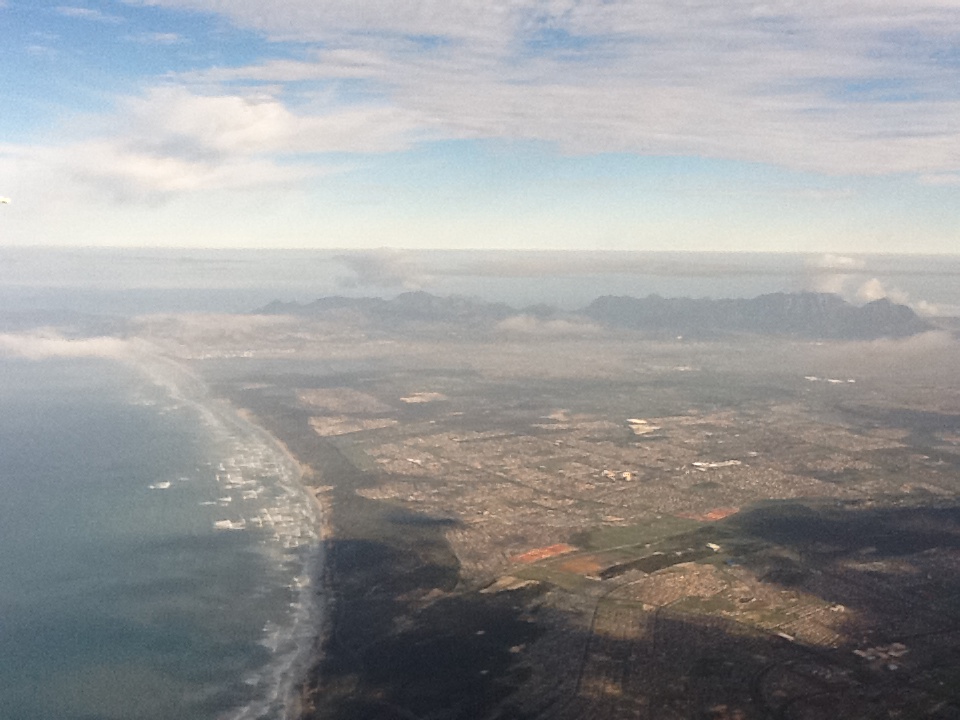
The most beautiful view in the world: Table Mountain from the window of a Boeing. After five days in Gauteng, home sweet home.


Sunday, June 12, 2011

Free at the top

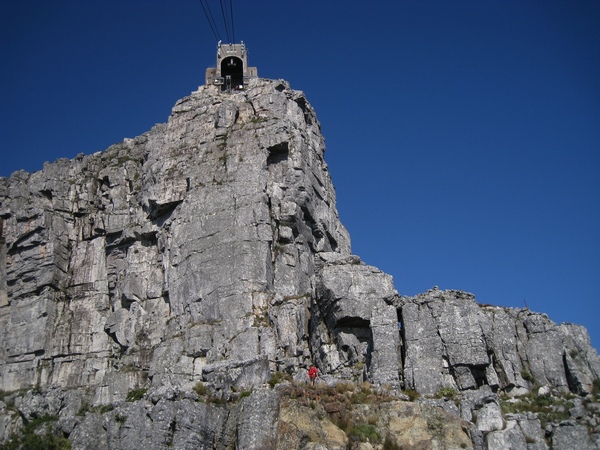
The colours on top of the mountain are blue, bright blue and deep blue. I don’t know about you, but it’s been ages since I’ve been on the actual flat tabletop bit; the western table, if you’re looking at a map. The part where the cablecar ends and a lot of tourists walk around. 
The Table Mountain Cableway’s new cable card is a great offer. For R490 per person you can go up and down the cableway as many times a year as you like, but not more than one return trip a day.

So this morning, when Jan and I felt like an easy post-flu stroll but still needed to be on the mountain and smell the fynbos, we had the brainwave to buy the cable card and put it to work immediately. We sailed up and the best thing of all was the sense of wonder on every face - including our own - even though we had done this many times before.

At the top it took us just a few minutes to shake off the crowds and walk towards Maclear’s Beacon (named after an astronomer who also has a crater on the moon named after him).  

This path is close to the blue sky. Clumps of reed-like restios stand ankle deep in pools of shallow winter water reflecting all that blue. A winter’s day like this is a perfect Cape Town day. Not a breath of wind, mellow sunshine and, up here, the croaks of tiny frogs like hairline cracks in the still air.

The route that loops back from the beacon takes you along the edge of the mountain and sudden, original views of the city, seen from the sharp side of the mountain. It’s like floating to the roof of your room and looking down at a familiar scene. Below us the cliff face dropped hundreds of dizzying metres. Although it’s not really exposed, it’s exhilarating to feel as if you’re walking along on the edge of the mountain, with the ocean a kilometre below you. 
Wisps of cool night air hang over the Atlantic Ocean, below the Twelve Apostles.
Ahead of us Table Mountain was a massive chunk of reassuring sandstone, with Lion’s Head looking very small from up here. And then we were back where we started. An hour and a half’s easy stroll, but a great mountain high. No sweat. At all. Just flash those cable cards.


Friday, May 27, 2011

Under the bush it is dark


Friday afternoon on the pipe track above Camps Bay. Twelve Apostles reflected in puddles filled with Wednesday’s rain. Sun smudged by a bank of clouds; two cold fronts on the way. River of light swirls on the horizon as the sun moves to another continent, another dawn, another day, towards summer somewhere far away. Under a bush a Cape Francolin scrabbles and lies down for the night. Under the bush it is dark. 


Wednesday, May 25, 2011

Do you know where we are?

“Do you know where we are?” In front of us stood four teenagers with bulky backpacks. The girl who asked the question had a much creased and well used map of Silvermine in her hands. I don’t think it was hers.
It turned out they were Scouts, let loose for the weekend in Silvermine on a mission to find their own way to the Amphitheatre. They hadn’t done badly. They were in fact close to the Amphitheatre, even if they were heading in the wrong direction. And judging by those backpacks they were, as Scouts should be, well prepared. There were two boys and two girls in the pack and just in case you didn’t know, the days of Girl and Boy Scouts are over. It’s just Scouts now.
I was so happy to see these four Scouts challenging my preconception that most teenagers spent their weekends in half-dark rooms killing everything in sight on their playstations, that I said: “We’ve just decided we’re also going to the Amphitheatre.”
We had our own little scouts-in-training behind us. Eager little walkers, each one of them. Erin-Joy and twins Gabrielle and Chiara. There is something wonderful about showing a little girl a fresh pink flower and telling her it’s an oxalis purpurea, only to hear it repeated when she spots one a little further on: “Oxalis purpurea!”

Of course, if you have children (I don’t) you would know that refreshments are key to keeping children interested in spending a morning on the mountain. So we found a protected overhang above the Amphitheatre and spread out along the rocks like a happy extended Khoi-San family, munching and chattering.

Our Scout troop marched on and we watched them cross the valley with a touch of pride.
By now Silvermine was spotted with sunshine, clouds racing shadows across the mountain.
“Mommy, I want to spend the whole day on the mountain,” a little voice piped up. Have you ever heard more beautiful words from an eight-year old.

Monday, May 16, 2011

Gifts from Cecilia

Winter is beautiful.Tightly packed in our waterproofs, we walked through Cecilia Forest up to the waterfall. It was a mega-rich walk: mist swirling through the trees, orange and yellow leaves twirling and dropping softly to the ground, Cecilia stream fresh and filled with new rainwater.Today's blog is filled with pictures, not words.
Early winter in lace.

Cecilia Waterfall with the mist swirling in the trees above.
As it is.

Rock with elaborate ancient ridge necklace.


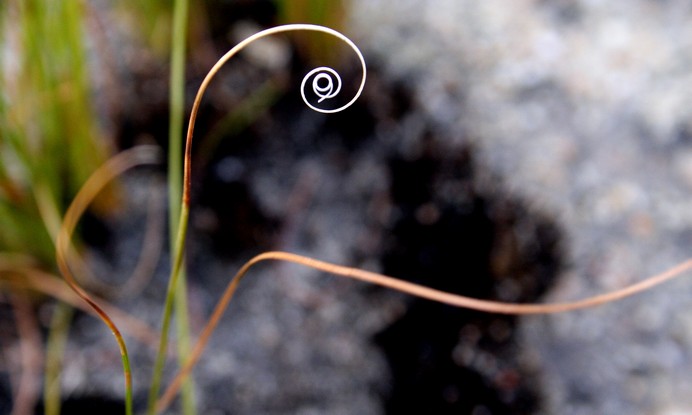
This glittering jewel lay next to the path, neatly framed by a curved sprig of dry grass. So perfect.

Monday, May 2, 2011

Damp glampers find a blue sky

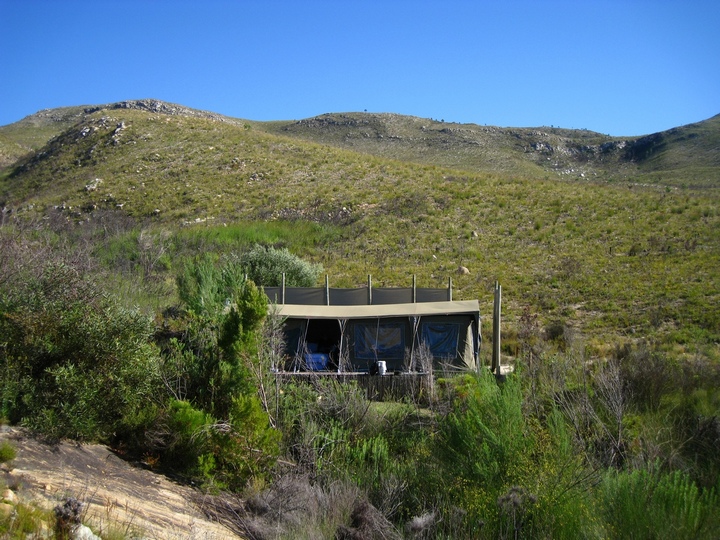
Our 'glampsite' at Kol Kol Mountain Lodge.

Last week we went ‘glamping’ in the mountains above Bot River, which is the new word for glamorous camping. That means a semi-permanent tent with a nice big bed and a white duvet, an outdoor hot tub and – most importantly of all – a three-bar gas heater.
Because it rained and rained. And then rained some more. Followed by snow on the highest peaks. The ‘glam’ in ‘glamping’ was disappearing as fast as a sunray in a downpour and we were rapidly becoming far more damp than glam. It gets worse. We found a pack of cards and were reduced to playing rummy. My husband Jan drew the line at snap, even though I suggested strip snap. Someone has to stay rational.
But it was all worth it, because on the sixth day the sun came out and danced shamelessly over the fynbos as if it had never been away.  We strapped on our boots, packed in a flask of tea, built a king-size sandwich that would last a day and got out.
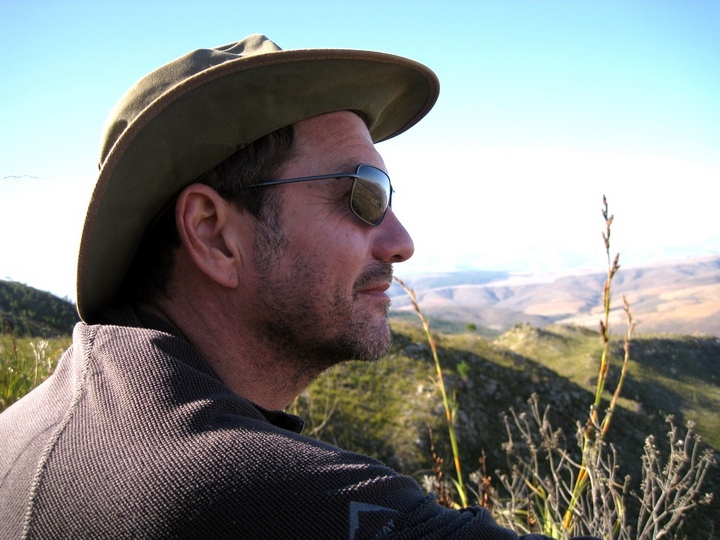
My fellow rummy player and explorer.
We had the whole world to ourselves. Soon we were over the borders of Kol Kol, the farm where we were glamping and heading further and further up. We couldn’t get close enough to that spotless blue sky. A few days before we had forced ourselves to set out for a waterproofed walk in the rain and had got to the top of the same ridge in a galeforce wind with an icy horizontal rain cutting through us. Now it was a different place: friendly, warm and stretching out around us into far dusty-blue horizons.
Rocky outcrops sat white in the fynbos, towering up like deserted old mansions. Not a smooth curve in sight. Nothing could ever stay smooth in a wild place like this with its raging winds, freezing rain and scorching sun. But not today. This day, the sixth day, was a peach. We walked and walked, eventually hitting a sandy jeep track that pulled us towards a hidden gorge. We knew the way home, but had no idea of the way forward. We let our feet find the way in this free place beyond people and guide books and it was wonderful.
Winter's first oxalis purpurea.
Long strands of restios waved in the wind and new tufts of bright-green, red and pink fynbos stuck their heads up in the recently burnt veld.
Then suddenly, in the middle of this valley, three figures emerged in the distance. Like two aboriginal songlines our path and theirs finally met in the middle. One man had a sturdy walking stick and a dog like Lassie and called out, “morning!” His name was Simon and he was the owner of this universe. Theoretically we were trespassing, but fortunately Simon seemed to enjoy the fact that we were enjoying it so much too. “Follow that path over there for the best views,” he pointed out. “It doesn’t seem right that someone should own a place like this,” said Jan, as we walked off.
Common Pagoda (mimetes cuculatus)
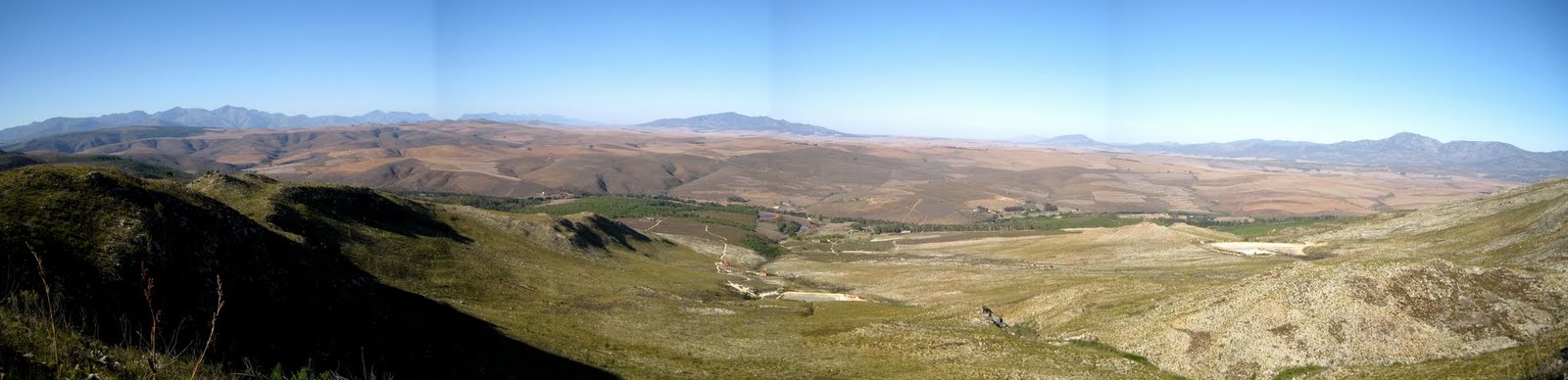
We followed Simon’s instructions and suddenly there it all was. Below us was the entire Houwhoek valley, from the Houwhoek Hotel on the left to the huge Steenbras dam wall on the right. Green squares of apple orchards and round blue dams filled the long valley between two mountain ranges and the N2 cut through it with its shiny steady stream of cars.
We found a spot out of the wind to have lunch, and I turned until I could sit and look at the big mountains above us. I far preferred the big untamed world up here to the ordered pretty one far below.

Even so, it was nice to eventually walk down one last hill and spot ‘our valley’ down below, cradled by mountains with ridges like long arms. Before us the ochre farmland and stubby hills of the Overberg bleached into the furthest range of deep blue mountains and what would surely be the next wild universe.
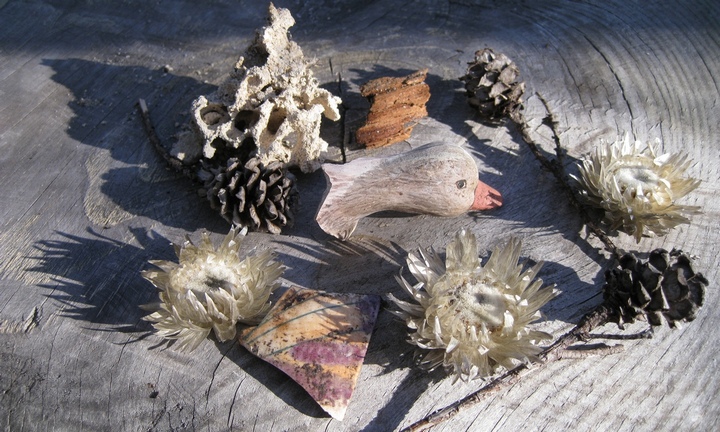
Things I found lying on the ground: a shard of a teapot, a porcelain duck's head, three everlastings, a piece of an anthill, three burnt leucadendron cones and a small piece of wood.